
Hannover Exhibition took place between the 20th of November and the 1st of December, in order to promote the content generated along the development of APS project.
On the 28th of November, a public presentation was organised, Chiara Farinea from IAAC illustrated the project, this was followed by a Roundtable with Jorg Schroder and Emanuele Sommariva from the Leibniz University of Hannover.


]]>

The opening of the APS Exhibition in Barcelona took place in the new building of the Institute for Advanced Architecture of Catalonia on the 13th of November after the Responsive Cities Symposium 2017.
The exhibition is a selection of best projects included in “State of the Art and Best Practices Collection” and “Implementing technology towards active public space. “How to” Guide” publications, developed within the framework of Active Public Space Project. Also, visitors can cast a look at the installations carried out during the project in Barcelona, Prague and Vienna (PobleJoc, Air-Move-Sound and Kepos).


The best projects from the Responsive Cities Symposium Call are also displayed at the exhibition


pdf: IAAC_RC_program.pdf
You can find more info at the symposium website:
]]>
Don’t miss the Air – Move – Sound event in Prague on the 15th of August!
In Pavlova Square from 2:00pm to 8:00 pm with intermediate artist Michal Kindernay we will discuss with the inhabitants of Prague, who are passing through the town every day, about the possibilities of improving the I.P. Pavlova Square. At the same time we want to inform the public about the movement of people, air quality, and noise in one of Prague’s most polluted places. Measured data, processed in comprehensible form, will be communicated through a series of postcards, interactive website and with artistic and social events.
For more info: http://magistrala.eu/
]]>

On the 6th of June at MAK Museum UAAV installation KEPOS will open to the public. It will be available until the 22nd of June.
Combining knowledge on smart planning and smart technologies with citizen participation, KEPOS highlights architecture’s integrating and innovative role in implementing sustainable urban developments. Actively engaging citizens, the installation is showcasing the potentials of information and communication technology (ICT) in public spaces for user interaction and participation, thus raising interest in architecture and public space among a broader audience.
Connected to the internet, KEPOS engages via social media with the community, transforming its space into an active participant of urban life. Therefore, the pavilion is not only designed to provide a semi-private shelter in the urban context but it also engages by communicating its current status.
Using light KEPOS will show the current status of the plants’ need for water. At the same time when the plants are in need of hydration it will post on social media.
The engagement asked of the participants is to touch the plant in need of water thus activating its hydration. KEPOS will be monitoring and posting online the air quality, temperature and light conditions inside and outside of itself to inform on the micro-climate being created.
Follow the project on Facebook and Twitter to get updates on the development of KEPOS.
For more information follow this link to MAK.
KEPOS is also part of the Vienna Biennale


Don’t miss it!
]]>
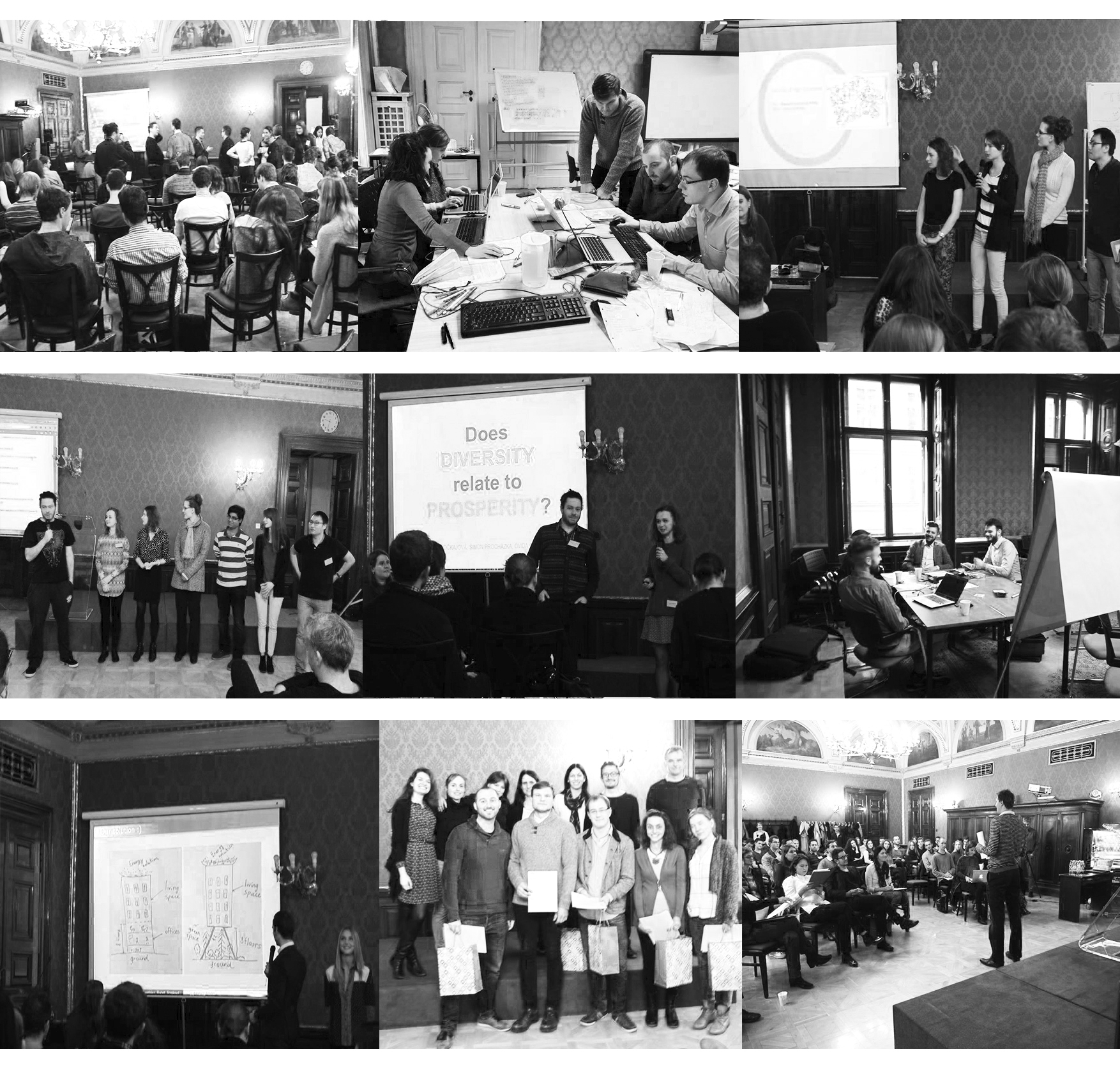
The Dathaton workshop occurred in Prague between the 11th and the 13th of November 2016 at Carge premises. 50 students attended the workshop.
The central theme was the activation of Prague public space.
The students were provided with a set of data, that have been analysed in order to improve city or governmental policies as well as concrete spaces. All data used by the students has been divided in 916 microdistricts. They could be combined to neghborhoods and these added up to municipalities.
How can data help to actively shape cities? How can we activate public space by data usage? How can citizens collect data and actively shape their city? Those are some of the questions on which the students were focusing during the three intensive days, exploring new solutions.
The students proposals focused on three main topics:
1 – Urban Movements
The students focusing on this topic were analysing the city’s main traffic arteries as well as alternative routes of commuting, in order to adapt and create a more efficient traffic system. They tried to reveal the potential dynamics and needs of spaces in the city. Moreover they put an effort on finding alternative transport tools, focusing on the effect of limited parking zones, alternatives for Prague and transportation in neglected zones.
2 – Diverse city
Multiculturalism, different lifestyles and economic backgrounds are essential for contemporary metropolis. Students tried to find solutions for balancing varied situations in the urban space, exploring the diverse city. Platforms related to food, culture and politics have been explored as potential solutions. The impact of social networks in communicating the related events, creating new routes within the city. have been assessed.
3 – Bottom-up Impact
Virtual tools can allow a more participative urbanism, through mapping for example. The role of social media in urbanism is a theme that has emerged in the past 15 years. Many platforms are created by users in order to communicate or give the tools needed to express an idea. The data-driven participatory and interactive mapping have been studied by the students as a tool that can empower people to appropriate the space which they inhabit. The students focused on understanding how can virtual distributed tools allow for a more participative urbanism, what are the most innovative ways to collect information, how can more statistically significant, unbiased data be generated for better policy making, what kind of data is currently needed but not collected to solve the city’s problems.
During the workshop the following lectures have been given:
Online-Sharing-GPS
Bernhard Sommer, University of Applied Arts in Vienna
From Data to Better Governance
Lucie Stejskalová, Strategy and Policy Department at Institute of Planning and Development in Prague
Evaluating Access to Universal Digital Highways
Gabriel Ahlfeldt, London School of Economics and Political Science
Visualization and Interpretation of Data
Mathilde Marengo, Institute for Advanced Architecture of Catalonia
During the last workshop day eleven teams working on urban topics of Prague such as public transport, abandoned places, residential real estate, livable city, and many more, presented their work to the international jury.
The students Robert stickney, Karel Golan, Eva Horakova, Greta Solari and Michal Kubista were awarded with a special mention for the project developed, each one of them received a 1,000 USD scholarship for the MA in Applied Economics program or ARCHIP masters program.

APS Barcelona Installation was developed in the framework of the #SUPERILLA pilot project, which goal is to test in the area of San Marti district the Superilla Plan for Barcelona. The plan aims at closing to the traffic a part of the city roads, creating pedestrian areas and public space, following the scheme below:

SUPERILLA MODEL

SUPERILLA PLAN FOR BARCELONA
Five Barcelona schools of architecture have been invited to set up installations to activate, between the 12th and the 22nd of September 2016, the new public space generated in the #SUPERILLA pilot project area.
IAAC participated with APS workshop students, developing the POBLEJOC installation, conceived during the Barcelona workshop.

POBLEJOC have been designed as an Urban Game with the aim of activating public space. A bench incorporating a tree, an urban orchard, a market stall, a ping pong table and a screen, all mobile (on wheels), are the elements that were positioned in the #SUPERILLA pilot project area. They could be moved by the users creating different configurations, reflecting the citizens’ desires in terms of design, hence activating the public space.
The space configurations were mapped through the use of a drone, to extract data on the space dynamics. The data were projected on the screen module during the night, offering a new point of view on space usage.

As part of the POBLEJOC installation, an augmented reality application was developed, which was used to digitally overlay information about the activities and functions of the installation.
Using a QR code, the users could download the application, freely available for Android and Apple phones, and use it to get more information on each module of the installation. By pointing their phone cameras to the physical markers of each module, digital information was overlayed on them, regarding the program and location of different activities related with the installation, as well as related general information about the city.
By introducing this digital layer to the installation, the aim was to further engage the public in both the physical and the digital layer and to provide a second level of interaction, through information and social media.
Data visualised
Screen tag: general info on the project; 3D model of the Superilla
Bench tag: twitter feeds with the #Superilla hashtag
Pods general tag: info on urban agriculture in Barcelona
Pods specific tags (one tag per plant): nutritional value and days to grow for cauliflower, lettuce, enciam, beans.
Table tennis general tag: map with sports locations around the area
Table tennis specific tags: calories burned, optimum temperature and relevant time of the day to practice for swimming, cycling, running, table tennis, volleyball
Market tag: market’s weekly schedule

NOTE:
> If you want to see more project pictures, please follow the link to the APS Facebook Page
]]>

Call for applications to participate to Barcelona workshop is now open!
The workshop (September, 5th– 7th 2016) will focus on the principles, implications and applications of ICTs for urban space and will include the following modules:
- parametric design based on environmental conditions and selected data
- real time data visualization
- digital interfaces for the design and participatory management of public space
- urban monitoring devices
- smart advanced materials and applications in the built and public space
- lectures by IAAC experts on technologies developed for smart energy management
The call is open till the 18th of August 2016.
In order to apply please send your cv to [email protected] providing the following information: Name / Age / Nationality / Education / Work experience / Experience in public projects & activities. Please write in the e-mail subject: BCN workshop application.
For further information:
]]>
The VIE workshop took place in Vienna between the 8th and the 10th of June 2016 at UAAV premises. 11 students attended the workshop.
The aim of the workshop was to provide participants, through lessons and practical exercises, with the necessary knowledge to design Active Public Space.
Each participant in the workshops developed technological skills and get understanding of parametric and sustainable design, new smart and sustainable materials for construction, the potentials of different hardware and software applications in public space and methodologies for citizen participation, thanks to lectures and tutorials (VIE Workshop_Program).
The workshop the following lectures have been given:
on Energy Design & Workshop Task
Bernhard Sommer and Galo Moncayo, University of Applied Arts in Vienna
Arguments on Public Space in Vienna
Beatrice Stude
Citizen Participation
Igor Kovacevic
on Micro-Climate in Urban Public Spaces
Matthias Ratheiser
Visualization & Interpretation of Data
Alexandre Dubor
On Interactive Systems
Saman Saffarian
Moreover the following tutorials have been given by Galo Moncayo
- Arduino
- Digital Mapping of Real Space Using Sensors
- 3d Modeling of Interactive Geometry
The students developed projects of interactive prototypes for the public space.
During the last workshop day the students presented the work developed in front of a jury composed by: Andrea Börner (UAAV), Chiara Farinea (IAAC), Anna Gulinska (UAAV), Yvette Vašourková (CCEA), Bernhard Sommer (UAAV), Beatrice Stude, Reiner Zettl (UAAV)


Call for applications to participate to Vienna workshop is now open!
The workshop will focus on energy design, and climate related aspects of the public space and will include:
- Teaching and practice of monitoring climate data from weather stations
- Visualization and interpretation of data
- Teaching and practice for parametric design based methodologies on environmental conditions
- Lectures by UAAV Experts on Energy Design
- Production and testing of interactive mock-ups (arduino)
- Documentation of discussion, and user behavior
- Final public presentation of realized work and closing discussion
The call is open till the 25th of May 2016.
In order to apply please send your cv to [email protected] providing the following information: Name / Age / Nationality / Instruction / Work experience / Experience in public projects & activities. Please write in the e-mail subject: VIE workshop application.
For further information: APS-Workshop-UAAV
]]>